
RELATED Live.
- About us
- Find Hospitals
-
KIMA Doctors
- All
- Anesthesiology
- artificial joint center
- Breast and Endocrine Surgery
- Breast cancer and thyroid cancer center
- Breast Surgery
- Cardiology
- Cardiothoracic Surgery
- Cerebrovascular Center
- Colorectal Surgery
- dental and maxillofacial surgery
- Dermatology
- Endocrinology
- Gastroenterology
- General Surgery
- Genito-Urology
- Hematology
- Hemato-oncology
- Infection Center
- Internal Medicine
- International Healthcare Center
- Korean Medicine
- liver center/Pancreas and billiary tract center
- Liver Transplantation
- Neurology
- Neurosurgery
- Obstetrics & Gynecology
- Ophthalmology
- Orthopedic
- Otorhinolaryngology
- Pediatric & Juvenile
- Pediatric Allergy and Respiratory Diseases
- Pediatric Gastroenterology
- Pediatric Neurology
- Pediatrics
- Physical Medicine & Rehabilitation
- Plastic & Reconstructive Surgery
- plastic surgery
- Pulmonology
- Radiation oncology
- Rheumatology
- Thyroid & Endocrine Surgery
- Urology
- Vascular Surgery
- KIMA News
- KIMA Live
- Community
KIMA NEWS
The research team led by Dr. Hong-man Yoon at the Center for Gastric Cancer, National Cancer Center (President Han-Kwang Yang), in collaboration with Kookmin University, has developed a technology capable of identifying stomach cancer tissue in real time during surgery.
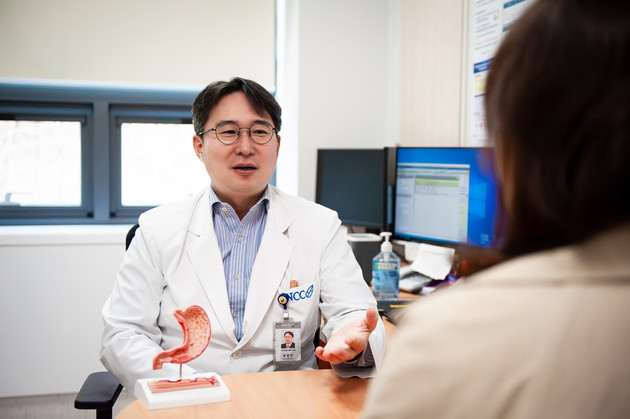
This breakthrough technology combines artificial intelligence (AI) with autofluorescence spectroscopy—a method that analyzes the subtle, natural light emitted by tissues—to help surgeons quickly and accurately determine the exact location and boundaries of a tumor.
Stomach (gastric) cancer remains one of the leading causes of cancer-related deaths worldwide. Accurately identifying tumor margins during surgery is critical to the success of the procedure. However, the current standard requires resecting the tissue and sending it to a lab for pathological evaluation, making immediate on-site judgment difficult.
To overcome this, the research team focused on autofluorescence spectroscopy, which requires no separate staining or preparation. However, this method previously suffered from limitations: measurement results varied by equipment, it was highly susceptible to environmental factors, and overlapping light signals made clear differentiation challenging.
To solve these issues, the team developed a custom environmental control device that maintains constant temperature, humidity, and lighting. They then trained a deep learning-based AI with the data generated under these controlled conditions, enabling the system to precisely separate complex, mixed light signals.
The resulting technology demonstrated an 88.1% accuracy rate in distinguishing cancerous tissue from normal stomach tissue, proving its capability to map out tumor boundaries almost instantly during an operation.
"This is an innovative study that overcomes the shortcomings of conventional light analysis methods through AI and environmental control technologies," said Dr. Hong-man Yoon, Head of the Center for Gastric Cancer. "In the future, this will significantly assist surgeons by allowing them to verify tumor margins right inside the operating room."
Conducted jointly with Professor Hyeong-min Kim's team at Kookmin University, this study was supported by the National Cancer Center's Public Interest Cancer Research Program and the Basic Science Research Program of the Ministry of Science and ICT. The findings were published on March 4, 2026, in Analytical Chemistry (IF 6.7), a prestigious international journal in the field of analytical chemistry.

Inquiry